

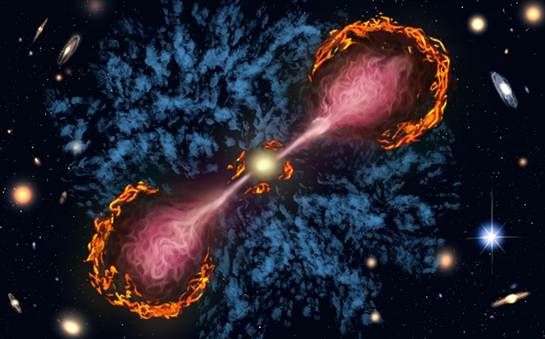
Astronomers have identified a possible mechanism through which supermassive black holes at the centres of galaxies can influence the vast reservoirs of gas surrounding their host galaxies, potentially affecting the formation of new stars and the long-term evolution of galaxies. The study was carried out by researchers from the Raman Research Institute (RRI), an autonomous institute under the Department of Science and Technology, and Arizona State University.
Beyond the visible stellar disk of a galaxy lies a diffuse envelope of gas known as the circumgalactic medium (CGM). Extending up to 10–20 times the size of the galaxy, this gas reservoir provides material that can eventually fuel star formation. Astronomers have long explored how energy released by supermassive black holes could prevent this gas from cooling and collapsing into stars.
The researchers investigated whether powerful jets of hot plasma launched by black holes could influence the CGM. Their observations indicate that when these jets encounter the surrounding gas, they deposit energy along their path, heating and ionising the gas. This process can disturb the cool gas needed for star formation.
The team searched for the characteristic glow produced by energised and ionised gas in the CGM. While no significant signal was detected when measurements were averaged in all directions around the galaxies, a strong signal emerged when the observations were examined along the direction of the black-hole jets. This suggests that the jets illuminate and influence the gas preferentially along their path rather than uniformly in all directions.
The signal was found to be particularly strong at two locations: near the edge of the stellar disk, where the jet first encounters the CGM, and near the outer boundary of the CGM, where the jet, after slowing down, interacts again with the surrounding gas. Researchers compare the energy transfer to the effect of a punch encountering resistance, with energy being deposited into the surrounding material.
The findings provide observational evidence for a possible connection between activity near a galaxy’s central black hole and processes occurring much farther away in its gaseous environment. Published in The Astrophysical Journal Letters, the study adds to efforts to understand how black-hole activity can regulate star formation and influence whether galaxies remain actively star-forming or become relatively passive.