

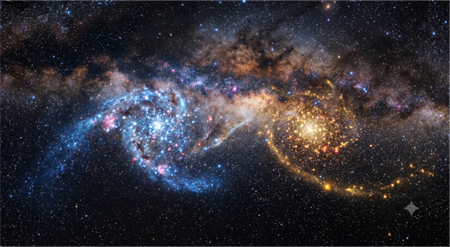
A team led by Indian astronomers has made a significant discovery by redefining the star cluster UBC 63 as a double cluster system, providing fresh insights into the formation and evolution of star clusters.
The discovery suggests that UBC 63, previously identified as a single star cluster, is actually composed of two distinct but gravitationally related stellar groups. Researchers identified this unusual configuration following an investigation into the system’s close flyby, which played an important role in understanding its present structure.
The findings could help astronomers gain a better understanding of how gravitational interactions influence the evolution and dynamics of star clusters. Close encounters between stellar systems can significantly affect their structures, potentially leading to complex configurations and changes in their gravitational relationships.
The research also highlights the growing contribution of Indian scientists to advanced astronomical investigations and space science. By combining observational data and scientific analysis, the team has contributed to a deeper understanding of stellar systems and their evolutionary processes.
The discovery of UBC 63 as a double cluster system marks an important development in the study of star clusters and offers new opportunities for further research into the effects of close stellar encounters.