

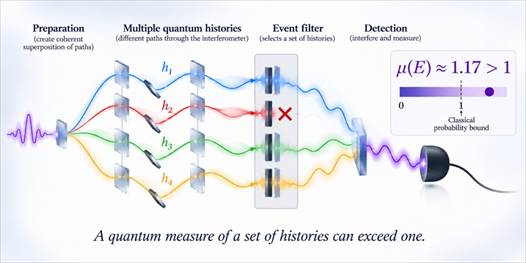
Indian researchers have experimentally measured a quantum measure exceeding one, marking a significant step in bringing Quantum Measure Theory (QMT) from the realm of theoretical research into the laboratory. The experiment was conducted by physicists at the Raman Research Institute (RRI), an autonomous institute under the Department of Science and Technology.
Unlike conventional probability, which cannot exceed one, a quantum measure can incorporate interference between different possible histories of a quantum system. In the experiment, researchers measured a quantum measure of approximately 1.17, closely matching the theoretical prediction of about 1.18 after accounting for experimental imperfections.
The researchers developed an optical “event-filter” to make the quantum measure experimentally accessible. Photons travelling through different routes in an optical setup were distinguished using their polarisation. The researchers then selected a specific collection of routes and subsequently erased the distinguishing information, allowing the routes to interfere. Measurements of input and output laser powers were used to infer photon-detection probabilities and determine the quantum measure.
Importantly, the experiment did not demonstrate a probability greater than one. The ordinary photon-detection probability remained below one, while the quantum measure exceeded one because it incorporates interference contributions from different possible photon paths. This distinction is central to understanding the significance of the result.
The study was carried out by Sanchari Chakraborti, then a PhD student at RRI, under the supervision of senior professor Urbasi Sinha, who is also a co-author of the paper. The research demonstrates that quantum measure, previously treated largely as an abstract theoretical quantity, can be accessed through an experimental setup.
The researchers say that a future version of the event-filter could potentially select specific collections of photon paths while keeping the photons available for further quantum operations. Such an approach could open possibilities for new methods of quantum measurement and quantum computing. The work does not test or resolve quantum gravity, although Quantum Measure Theory was developed in part in the context of efforts to understand quantum gravity.