

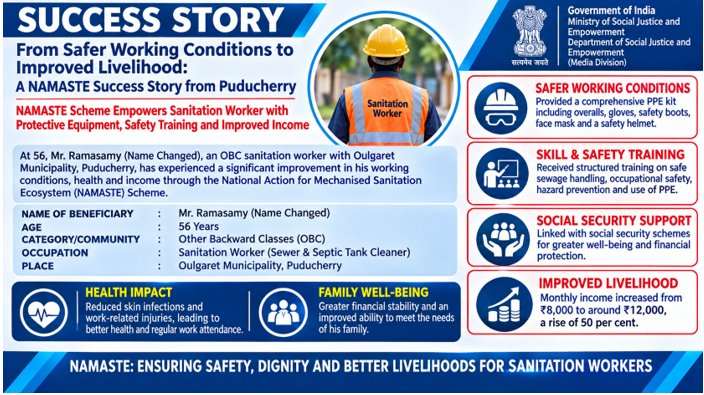
The National Action for Mechanised Sanitation Ecosystem (NAMASTE) Scheme is bringing positive changes to the lives of sanitation workers by promoting occupational safety, health protection and dignified livelihood opportunities. A recent success story from Puducherry highlights how timely government support can improve both working conditions and financial stability.
Mr. Ramasamy (name changed), a 56-year-old sanitation worker employed with Oulgaret Municipality in Puducherry, has experienced a significant improvement in his professional and personal life through the NAMASTE Scheme of the Ministry of Social Justice and Empowerment.
For several years, Ramasamy worked as a sewer and septic tank cleaner without adequate personal protective equipment (PPE), exposing himself to hazardous conditions. Recurring skin infections, injuries and physical discomfort frequently affected his health, work attendance and earnings. Supporting a family of four on a limited income was also a major challenge.
A turning point came in 2025 when he received assistance under the NAMASTE Scheme. He was provided with a comprehensive PPE kit comprising protective overalls, gloves, safety boots, a face mask and a safety helmet. He also received structured training in safe sewage handling, occupational safety, hazard prevention and the proper use of protective equipment. Additionally, he was linked with social security support.
The intervention helped him adopt safer working practices, reduce exposure to occupational hazards and improve his health. Fewer health-related disruptions enabled him to attend work more regularly and maintain continuity in his employment.
The impact was also reflected in his income. His monthly earnings increased from approximately ₹8,000 to ₹12,000, registering a 50 per cent increase. This improvement strengthened his family’s financial stability and enabled him to contribute more consistently towards household expenses and his children’s needs.
The success story demonstrates how the NAMASTE Scheme is working towards ensuring the safety, dignity and socio-economic empowerment of sanitation workers. By promoting protective equipment, safety training and institutional support, the initiative aims to build a safer, more inclusive and mechanised sanitation ecosystem across the country.