

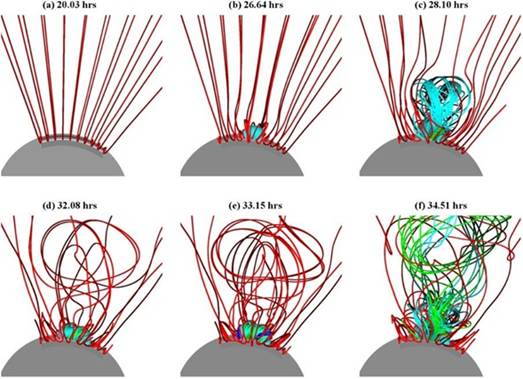
Scientists have developed a new three-dimensional computer simulation model that could bring researchers a step closer to forecasting the speed, arrival and potential impact of Coronal Mass Ejections (CMEs) before they reach Earth. Developed by researchers at the Indian Institute of Astrophysics (IIA), along with collaborators from the United States, Hungary and Finland, the model traces how magnetic energy builds up in the Sun’s outer atmosphere and is eventually released during powerful solar eruptions.
CMEs are enormous clouds of magnetised plasma expelled from the Sun at millions of kilometres per hour. When directed towards Earth, they can interfere with satellites, communications systems and power grids. At the centre of these eruptions are magnetic flux ropes—twisted bundles of magnetic field lines embedded in solar plasma. The new three-dimensional magnetohydrodynamic model follows the evolution of these structures as they rise through the solar atmosphere and eventually erupt.
Researchers found that magnetic reconnection initially develops gradually through the formation of a thin sheet of strong electric current. As the process intensifies, it culminates in the rapid expulsion of the flux rope into space. The study also found a clear relationship between the rate of magnetic reconnection and CME acceleration. As reconnection speeds up, the CME accelerates, suggesting that reconnection flux could help determine how rapidly and energetically a solar eruption develops.
The simulations were carried out using the NOVA high-performance computing facility at the IIA. Researchers also compared their simulations with observations from NASA’s Helioseismic and Magnetic Imager (HMI) and Atmospheric Imaging Assembly (AIA) instruments.
Published in The Astrophysical Journal, the study provides new insight into the chain of events that transforms gradually accumulated magnetic energy on the Sun into powerful solar explosions. The findings could contribute to the development of improved space-weather forecasting systems, helping scientists better assess the risks posed by future CMEs.