

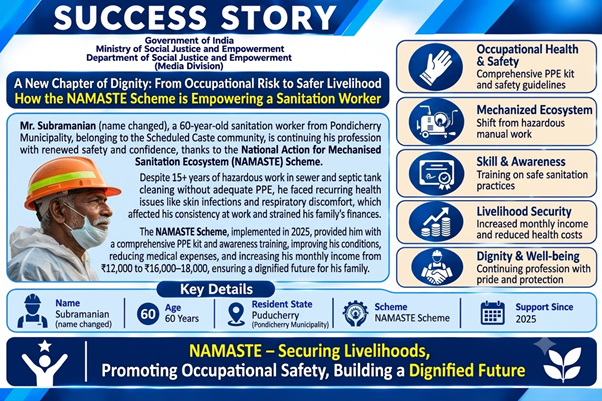
Ensuring dignity, safety and social security for sanitation workers is an important step towards building an inclusive and equitable society. The National Action for Mechanised Sanitation Ecosystem (NAMASTE) Scheme, launched by the Government of India, aims to transform the sanitation sector by protecting workers and promoting safe sanitation practices.
The scheme focuses on the safety, health and dignity of sanitation workers, particularly those engaged in hazardous cleaning activities. It promotes mechanised sanitation, provides access to safety equipment and training, and aims to reduce the need for workers to enter sewers and septic tanks manually.
Through initiatives such as skill development, health coverage, safety training and livelihood support, NAMASTE seeks to create better employment opportunities and improve the quality of life of sanitation workers.
The scheme also encourages the adoption of modern technology and mechanised equipment to eliminate unsafe sanitation practices and prevent occupational hazards.
NAMASTE is more than just a government initiative; it represents a commitment to social justice, human dignity and a safer working environment.