

Images courtesy: Mycelium Ecology

The vine snake felt smooth and gentle when I touched its tail with a mix of fear and fascination. The stream sang its song through the rocks with a sound that made me feel grateful. Cicadas followed us with their rhythmic calls wherever we went.
Where have I been, really?
Decades ago in high school, I had attended a jungle camp organized by Ramjas Foundation, which runs a clutch of institutions in Delhi. Living in a forest along a stream (a tributary of the river Malini if I remember it correctly) for 10 days has been one of my most cherished life experiences.
The second tryst with nature I’m now writing about lasted only a couple of days. But what I felt, saw, heard, and smelled is going to stay with me for as long as the senses that did all that feeling, seeing, hearing, smelling—‘noticing’, in a new parlance, as you’ll soon know.
While the student camp was characterized by learning about pug marks, scree running, doing night vigil duty, and scaling a peak in Uttarakhand’s Pauri Garhwal, this second forest visit had charms entirely of its own.
The forest is in the Kodagu district (better known as Coorg) of Karnataka and our stay—I was part of a motley bunch of 8-10 folks attending the Noticing Residency—was at a nearby homestay called Magnolia Mist. The area falls under the Western Ghats mountain range, which spans six Indian states and stretches more than 1,500 kilometers along India’s west coast.
I’ll come to the snake and the stream and the cicadas (and leeches, too!) but let me first introduce you to a living organism like few others.
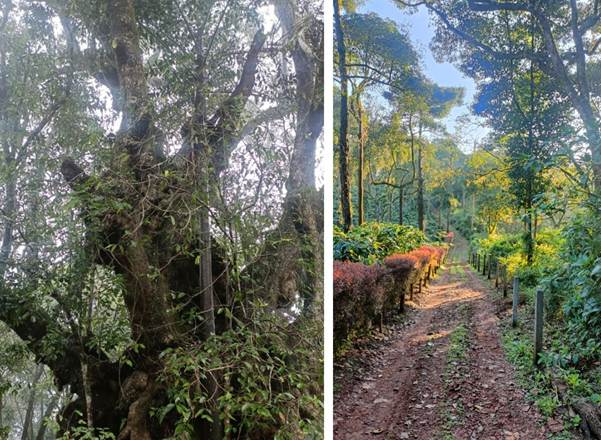
The giant magnolia (left) and a nearby path
Magnolia Mist takes its name from a magnolia tree (called Champa or Champak in Hindi; the botanical name is Magnolia champaca). Champak was one of my favorite story books in childhood; the Champak I saw on the way to the homestay immediately endeared me to itself. So much so that I stood spellbound and speechless for a few moments. Its girth was wide as an elephant’s, the spread of its canopy could shelter dozens of horses, and the hollows of its roots and branches—besides the bark, forks, crotches, and other nooks and crannies—served as living space for countless creatures.
My friend Pankaj Mishra, who organized the residency along with Mycelium Ecology, writes about the magnolia housing a porcupine family and hornbills. (How I wish I had spotted the porcupines!)
Just looking at that grand living, breathing structure, doing a circumambulation around it fit for a deity, and standing in its shade for a while made me feel supremely grateful. Trees always speak to me and this one spoke volumes without uttering a single word. But if I were to distill its silence into a few words, it would be these: Kindness. Love. Peace. Coexistence. Benevolence. And, yes, given its thousand-year life that must have witnessed humans wage countless wars and make futile attempts to force nature into submission: Timelessness.
I just bowed my head and went further toward more blessings awaiting my arrival.
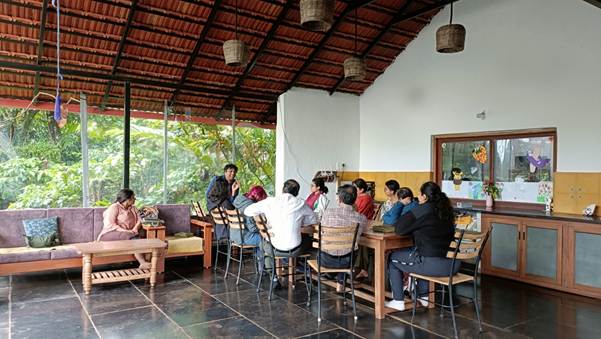
Pankaj with the first cohort of Noticing Residency
Entering Magnolia Mist was like walking into a dream. A few sips of the green tea offered to us in the dining hall—which was surrounded by plants, trees, a brick oven, and an aquarium—took one half of the tiredness away. The other half was claimed by the smiling faces of our hosts, Abhishek and Anna (to speak nothing of their daughter Aria, a walking-talking bubble of energy who is a living library of the place’s flora and fauna). Throughout our stay, not only did they keep us well-fed with organic food that smelled and tasted great, they looked after the “Noticing residents” just like family.
The homestay is set in a biodiverse agriculture farm growing coffee and vanilla, among a variety of other fare, overlooking paddy fields and the rolling hills of Coorg far and beyond. The hut where I stayed was spacious, picturesque, and designed to keep me wanting to stay longer than two nights!
Let me now tell you a bit about ‘noticing’ and the Noticing Residency.
The residency part is obvious: we were the first resident cohort.
It is the noticing part that’s simple and complex at the same time. It emerged sometime back when Pankaj saw—really, slowly, wholly saw—a tree leaf detach from the tree and fall all the way to the ground. In those few moments he must have paused, felt, observed, and contemplated on this journey of the leaf. He must have been fully absorbed in ‘noticing’ with all this being, with all his senses.
Most people often jump headlong into describing things, using all sorts of adjectives without really caring or feeling for what it is they are writing about—or what those (often) big words that come before nouns really mean.
“Two bonds are wounded. The one between us and nature, and the one between us and our writing. Let’s heal them both together?” Pankaj wrote in a post, announcing the first Noticing Residency along with Mycelium Ecology.
Writing is not the thing, he said. “Feeling is. Observing is. Being present, patiently.”
So Pankaj provided the noticing chops; Mycelium brought in the forest and the Mist.
For two days and nights, we went about finding our ‘noticing muse’, as it were. In our huts, in the biodiverse farm around us, on the paddy field with a rivulet running alongside, and in the Dancing Frog habitat, we roamed around looking for that falling leaf, that bend in the stream, that twig that rock that spider that butterfly that just flew past—whatever spoke to us. And once we found it, we stood or sat down near it, paused for a moment, observed it, noticed it as fully as we could without hurrying to put names to feelings that were still getting processed.
Back to our cottages, we wrote in our journals if we felt strongly about something or just chewed it over and over with our mind’s teeth. Then we returned to our points of noticing and did some more observing, feeling, sensing. Did something change? What or how? If not, why not? It wasn’t an academic or statistic-collecting exercise but listening to a heartfelt urge, an inner impulsion to see things as they are—perhaps not much different from Vipassana meditation.
We carried our journals and our newly acquired repertoire of noticing tools and best practices the next day to the piece of forest Mycelium actually bought in order to preserve it in as natural a form as possible. (Only a tiny percentage of the land is being developed for supporters-owners who share the organization’s values on conservation.)
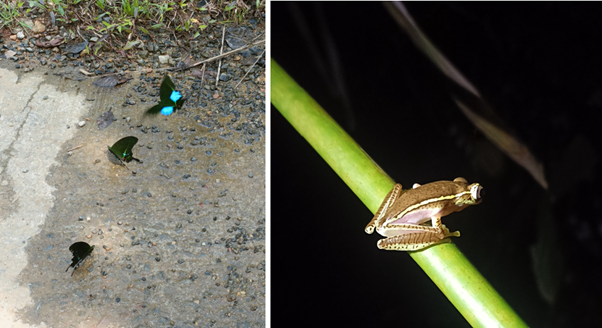
Paris peacock butterflies ‘mud-puddling’ and the small sliding frog
On our way to the Dancing Frog habitat, as our vehicles were moving on roads that wound through coffee plantations and the greenery all around, a few things shimmered ahead of us. Flitting about in velvety black wings adorned with blue patches that shone with an enchanting effect, they were Paris peacock butterflies. Three or four of them were taking turns to sip from a puddle of muddy water at the roadside. Some of us went closer but they remained occupied in their ritual—mud-puddling, through which they extract minerals for their nourishment.
We drew even closer and squatted on the road to do our observing, feeling, noticing. To our delight, they barely noticed us back and went about minding their own business—which, to be honest, was more important than a bunch of adult humans gawking at them like kids up to some mischief!
For a full 20-25 minutes, the butterflies took their fill and we took ours.
Soon, we reached our destination and gathered near the entry point. “The Dancing Frog habitat takes its name from a peculiar frog endemic to this region,” Nishanth Prasannan, the founder-CEO of Mycelium, told us. The male frog raises and waves one leg up in the air to attract females, an act that earned the species its name.
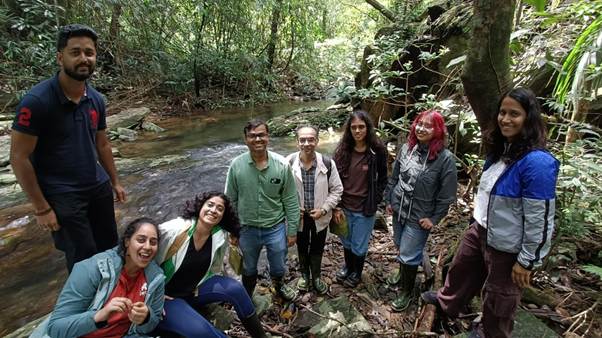
We entered the forest habitat and, within a few steps, were transported into another world—where pollution was replaced by fresh air, and honking was substituted by birdsong. I could feel and smell the forest’s breath as soon as I got in and heard the gurgle-burble-trickle of the stream flowing nearby (I think it is part of Harangi tributary of the river Cauvery). Before long, I found myself perched on a rock jutting out of the stream, with the rest of the folks taking their own positions, ‘noticing journal’ in hand, along the stream’s course. A few bravehearts waded through to settle on rocks bang in the middle of the rushing water.
I was sitting quietly and listening and seeing and observing. Noticing.
Between the silences and the observances, I made two entries in my journal, one of which I’m sharing below:
The stream is singing its song. Is it a fast song? No. A slow one? No, again.
There are no words but the stream seems to be saying something with the song.
I listen some more.
This song, right here, right now, belongs to this part of the stream. Rocks, water, and wind are humming it in a cadence that is unique to their confluent movement. I must stay where I am to listen to this same exact song.
The stream keeps singing.
I stay on, listening.
On our way back, Saloni Sawant from Mycelium pointed us toward a vine snake twisted around the twig of a shrub. Its green color camouflaged it among the leaves but she somehow noticed it. I felt tempted to feel it with my hand and, asking for its forgiveness in my mind lest I should disturb it, I touched its tail softly and quickly. It slithered away quietly.
We were back to Magnolia Mist by the evening.
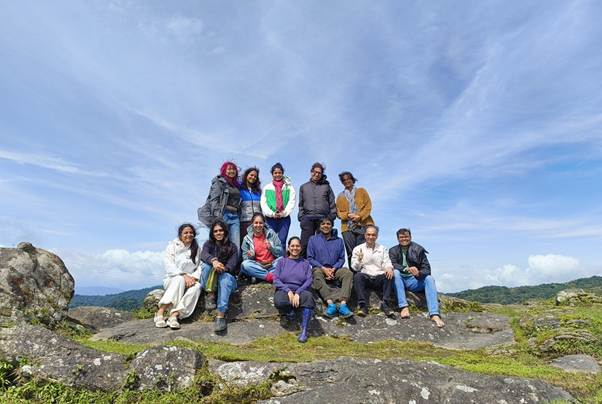
On a windswept hilly grassland
In between the homestay and the forest, we also visited a grassland and a hilltop from where the views of the rolling hills were breathtaking. At one place, I remember spotting clouds upon clouds strung together in a chain like a giant train floating in the sky. At another, the fragrance of the place felt like nothing I had ever encountered: the smell remains etched in my memory but defies description. Just recalling it has a healing effect on me.
Wherever we went, two things kept us company: the sound of cicadas and the bite of leeches.
After I came back I did some research on cicadas and discovered that, with their loud calls, cicadas are an important part of the soundscape of ecosystems and are good indicators of forest health. But back there at Magnolia Mist and Dancing Frog, they were our curious companions, making their cricket-like but shriller calls as if part of several welcoming bands playing their instruments in synchronized waves. It was quite a rhythm with one band taking over just as another finished its chorus.
The most discussed creatures of all, of course, were the leeches! They could appear silently out of nowhere (because they were everywhere in the region), attach themselves to your leg or other body part, and take a few sipfuls of your blood—without you even noticing (pun intended). Later on, you might see blood trickle down from your leg—or that of a cohort companion—and say, “Oh, my, when did that happen?”
Some of us were spared the bites or had fewer of them, thanks to the Dettol we had sprayed on our legs before venturing out. I sprayed myself once—then ditched it altogether when Abhishek told us that people often pay to get their blood sucked by leeches and here we were getting it for free! Once in high demand for treating various illnesses, leeches are still used in procedures such as finger or ear reattachments to help blood flow to the reattached tissue, according to an article in the Smithsonian magazine.
I’ll end this piece with my own little leech tale (Leech to their own, let’s say!).
After coming back from my noticing practice to the dining hall for dinner on our first evening, I was checking myself for leech bites. There were a couple of them on my legs. I rubbed the spots clean with a tissue (there was no pain but they would itch later). Then I saw a tiny wiggly thing at the tip of my left index finger—a leech biting me right under my nose! I held it gently with a tissue and put it outside near the plants.
Now, here’s the interesting, healing part. This leech had sucked the blood out of my finger at exactly the same spot that had been swollen and giving me trouble for the past several months. As I wiped the blood off my finger, I noticed that the swelling was gone—and so was the pain.
I whispered back my thanks to the forest.
(As a small tribute, I also put down a little poem on my experience. You can read it here.)
Sanjay Gupta is an independent writer, editor, and journalist with three decades of experience in India’s top media houses, including the Times of India, Indian Express, and Hindustan Times groups. A strong advocate of holistic living and yoga, he has been practicing meditation for more than 12 years. He is the author of two books, River of Love: Meditation beyond the App and Strings of the Soul, and co-author of 21 Jewels of Digital. For more details about him and to get in touch, you can visit: https://linktr.ee/thinksanjay