

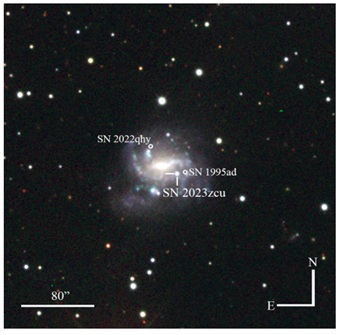
Astronomers are investigating the nature of a newly discovered supernova that could provide valuable insights for refining the cosmic distance scale—the framework used to measure distances across the universe. Understanding the characteristics of the stellar explosion may help scientists improve the accuracy of the “cosmic distance ladder,” a series of methods used to determine distances to celestial objects and gauge the expansion of the universe.
Supernovae, particularly Type Ia supernovae, serve as important “standard candles” because their intrinsic brightness allows astronomers to estimate how far away they are. By studying the newly identified event in greater detail, researchers hope to determine whether it can enhance existing calibration techniques and reduce uncertainties in cosmic measurements.
The findings could contribute to resolving longstanding questions about the universe’s rate of expansion, known as the Hubble constant, and improve our understanding of cosmic evolution. As observations continue, the supernova may offer a rare opportunity to test theoretical models and strengthen one of astronomy’s most important measurement tools.
Researchers say that every well-characterized supernova adds to the precision of the cosmic distance scale, helping scientists build a more accurate picture of the universe’s size, age, and expansion history.