

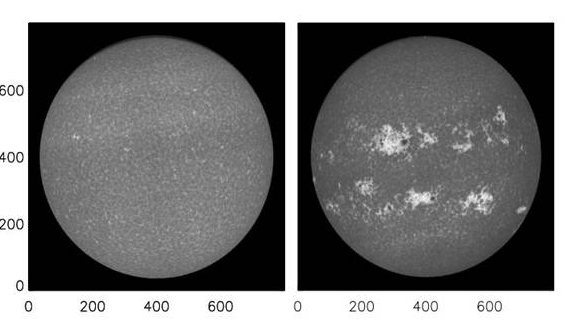
Scientists have uncovered fresh insights into the Sun’s 11-year activity cycle by analyzing more than a century of solar observations from the Kodaikanal Solar Observatory. The study reveals that large-scale convection patterns on the Sun’s surface closely track changes in solar magnetic activity, offering a new window into the processes that drive the solar cycle.
Researchers examined over 34,000 archival images captured in the Calcium-II K spectral line, which highlights magnetic features in the Sun’s chromosphere. The analysis focused on supergranulation—vast cellular flow patterns on the solar surface that play a key role in transporting magnetic fields.
The study found a strong correlation between the properties of supergranular network lanes and the Sun’s activity cycle. Variations in the widths and brightness of these lanes were observed to follow changes in solar magnetic activity, particularly in latitudes where sunspots are most commonly found.
Scientists also discovered a time lag between different surface indicators. While changes in network lane widths tended to peak around periods of maximum solar activity, brightness variations reached their peak roughly 1.25 to 1.5 years later. This delayed response provides new clues about how magnetic fields evolve and interact with convective flows on the Sun.
The findings are significant because the Sun’s 11-year cycle influences the frequency of solar flares, coronal mass ejections, and other space-weather events that can affect satellites, communication networks, navigation systems, and power infrastructure on Earth.