

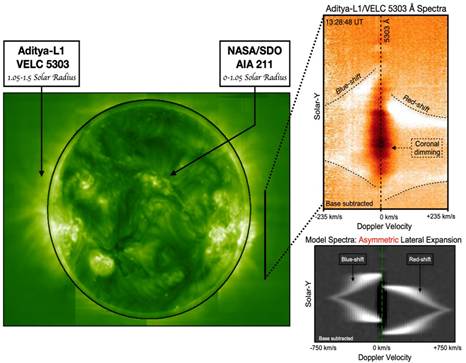
India’s first space-based solar observatory, Aditya-L1, has provided significant new insights into the behaviour of solar eruptions, helping scientists understand how these powerful events expand in the early stages and potentially influence space weather.
Using observations from the Visible Emission Line Coronagraph (VELC) onboard Aditya-L1, scientists from the Indian Institute of Astrophysics (IIA), an autonomous institution under the Department of Science and Technology (DST), have discovered that a coronal mass ejection (CME) does not necessarily expand uniformly like a symmetrical bubble. Instead, it can develop an asymmetric shape due to uneven expansion.
The research team combined spectroscopic observations from Aditya-L1’s VELC instrument with complementary images from NASA’s Solar Dynamics Observatory (SDO) and advanced three-dimensional modelling to reconstruct the geometry and movement of a solar eruption.
The study examined a CME that occurred on August 5, 2024, originating from an active region near the western edge of the Sun.
VELC detected unusual patterns in the Doppler shifts of the emitted light, revealing plasma moving both towards and away from the spacecraft. These observations provided scientists with valuable information about the movement of solar material along the line of sight, which cannot be fully captured through conventional two-dimensional imaging alone.
This research demonstrates the growing scientific capabilities of India’s Aditya-L1 mission and opens new possibilities for studying solar eruptions using observations from a single spacecraft, complemented by other imaging data.
Scientists expect that further studies using VELC observations will improve understanding of CME propagation and contribute to more reliable space-weather modelling and forecasting.