

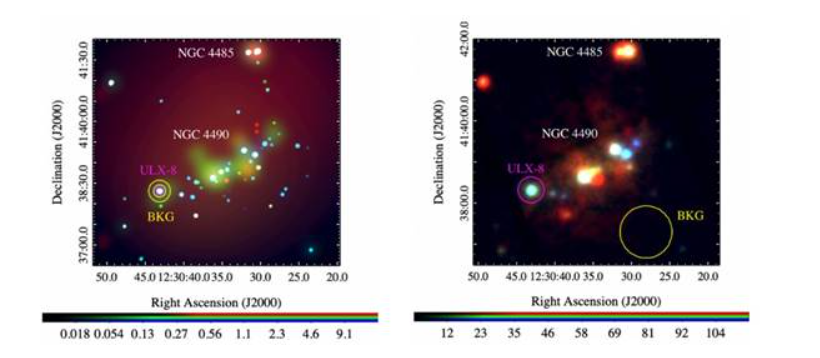
In a significant development in astrophysics, Indian astronomers have used 24 years of X-ray observations to investigate the mysterious behavior of one of the brightest X-ray sources in nearby galaxies, identified as NGC 4490 ULX-8. The findings provide important insights into the nature of ultraluminous X-ray sources (ULXs) and the extreme physical processes taking place around black holes.
The research was led by scientists from the Indian Institute of Astrophysics (IIA) and the Raman Research Institute (RRI), institutions under the Department of Science and Technology (DST), Government of India.
The research team analyzed observations collected between 2000 and 2024 using three major space-based X-ray observatories — NASA’s Chandra X-ray Observatory, ESA’s XMM-Newton and NASA’s Neil Gehrels Swift Observatory.
The study found that NGC 4490 ULX-8 is most likely a stellar-mass black hole accreting matter from a companion star at or near the Eddington limit. This limit represents the point at which the outward pressure of radiation balances the inward gravitational pull of an astronomical object.
The observations revealed significant long-term variations in the source’s X-ray brightness and spectral properties. However, despite these changes, the source did not exhibit the dramatic transitions between different accretion states commonly observed in many black hole X-ray binary systems. This behaviour indicates a persistently active ultra luminous accretion flow.
Press Information Bureau+1
Ultra luminous X-ray sources are exceptionally bright objects found outside the centres of nearby galaxies. They are believed to be powered by compact objects, such as black holes or neutron stars, drawing matter from companion stars. As the matter moves towards the compact object, it heats up and releases intense X-ray radiation.
The findings provide strong evidence that ULX-8 is powered by a stellar-mass black hole accreting matter at rates exceeding the classical Eddington limit. This offers valuable insights into super-Eddington accretion, powerful gas outflows and the growth of black holes under extreme cosmic conditions.