

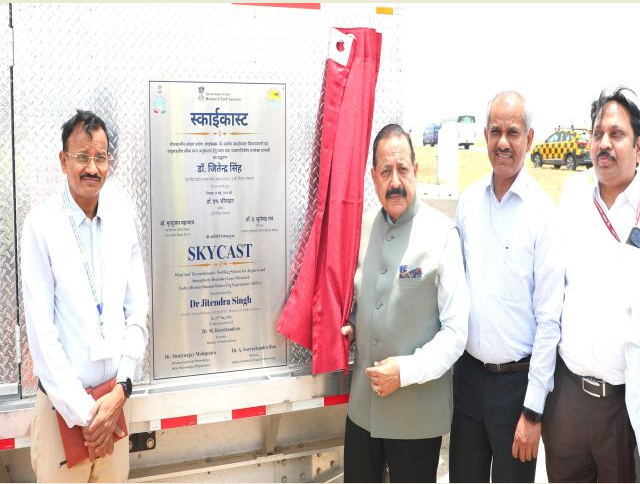
Union Minister of State (Independent Charge) for Science and Technology, Jitendra Singh on Friday inaugurated India’s first SkyCast aviation weather intelligence system at the Indira Gandhi International Airport (IGI), marking a major step towards fog-free and weather-smart aviation operations in the country.
Developed under the Centre’s Mission Mausam initiative, the SkyCast system integrates advanced atmospheric sensing technologies to provide real-time weather information critical for aviation safety and efficiency. The platform combines radar wind profilers, microwave radiometers, ceilometers, fog aerosol spectrometers and other remote-sensing instruments to monitor atmospheric conditions around airports.
Speaking on the occasion, Dr. Singh said the launch heralds a new era of weather-smart aviation in India, enabling more accurate forecasting and timely weather alerts for pilots, air traffic controllers and airport operators.
The system is expected to significantly reduce disruptions caused by dense winter fog, a recurring challenge at Delhi airport that often leads to flight delays, diversions and cancellations. By providing continuous monitoring of visibility, wind patterns, turbulence and moisture levels, SkyCast will support safer take-offs and landings, particularly during adverse weather conditions.
Officials said the technology can generate detailed atmospheric profiles up to several kilometres above the airport, helping aviation stakeholders make informed operational decisions in real time.
The minister noted that only a limited number of such integrated aviation weather monitoring systems are operational globally, placing India among a select group of countries deploying cutting-edge weather intelligence infrastructure for aviation.
The SkyCast facility at IGI Airport is the first of its kind in the country, with similar systems proposed for other airports, including the upcoming Noida International Airport at Jewar, as part of a broader effort to modernise India’s aviation weather forecasting capabilities.
The initiative builds upon research conducted under the Winter Fog Experiment (WiFEX), which has been studying fog behaviour and visibility conditions at Delhi airport for more than a decade.