

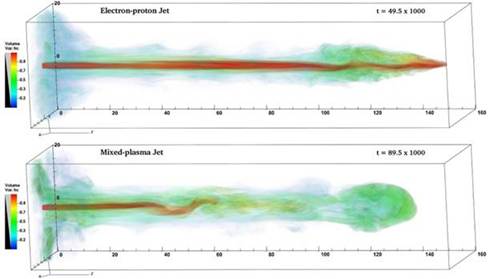
Astronomers have investigated why extragalactic jets emerging from regions around supermassive black holes display dramatically different appearances despite originating from similar cosmic environments. The study offers fresh insights into the physical processes governing some of the universe’s most energetic phenomena.
Extragalactic jets are powerful streams of charged particles ejected at nearly the speed of light from the vicinity of black holes located at the centres of galaxies. While some jets appear narrow and highly collimated, others spread out into diffuse and complex structures extending across vast intergalactic distances.
Scientists analysed how factors such as magnetic fields, surrounding gas density, black hole spin, and energy distribution influence the morphology and evolution of these jets. The findings suggest that variations in the environment surrounding black holes play a decisive role in shaping the observed structure and brightness of the jets.
Researchers noted that understanding the dynamics of extragalactic jets is critical for studying galaxy evolution, energy transfer in the cosmos, and the behaviour of matter under extreme gravitational conditions. The study also contributes to broader efforts to understand how black holes interact with and influence their host galaxies. The research is expected to aid future observations using advanced radio and space telescopes designed to probe deep-space phenomena with greater precision.