

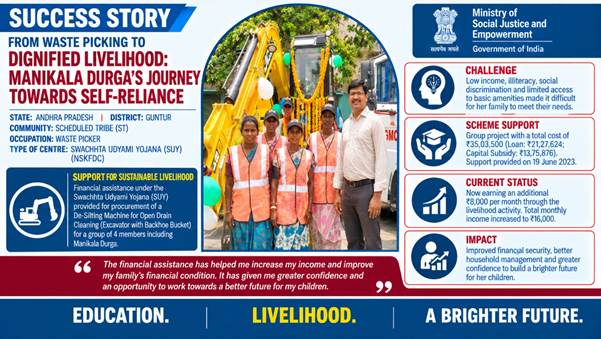
For Manikala Durga, financial assistance became the foundation for a new livelihood and a more secure future. After years of working as a waste picker, she has taken a step towards economic self-reliance through access to institutional financial support.
A member of the Scheduled Tribe community, Durga worked with the Guntur Municipal Corporation for nearly 15 years. With limited educational opportunities and a modest monthly income, managing household expenses remained a constant challenge.
A turning point came when Durga, along with three other beneficiaries, received support under the Swachhta Udyami Yojana (SUY). The assistance enabled the group to acquire a de-silting machine for open-drain cleaning, allowing them to undertake work as an organised livelihood activity.
The project, with a total cost of around ₹35.03 lakh, was supported through a combination of institutional finance and capital subsidy. The new equipment opened an additional source of income for Durga and her group while also contributing to improved sanitation services.
As a result, Durga’s monthly earnings increased from approximately ₹8,000 to ₹16,000, giving her greater financial stability and helping her meet the needs of her family.
Her journey demonstrates how access to appropriate financial assistance, combined with livelihood opportunities, can help vulnerable sections of society transition from traditional forms of employment to sustainable income-generating activities.
Manikala Durga’s story is ultimately one of opportunity—showing how targeted support can help turn a livelihood challenge into a pathway towards dignity, confidence and economic self-reliance.