

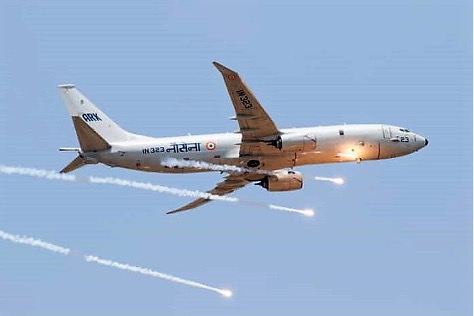
The Indian Navy marked the Golden Jubilee of its Long-Range Maritime Reconnaissance (LRMR) operations on November 18, 2026, commemorating five decades of airborne surveillance and vigilance in support of India’s maritime security. The milestone also marks the 50th anniversary of the commissioning of Indian Naval Air Squadron 312 (INAS 312), popularly known as the ‘Albatross’.
Commissioned on November 18, 1976, at INS Hansa, Goa, INAS 312 began its journey with five Lockheed Super Constellation aircraft transferred from the Indian Air Force. The development of this capability followed the 1971 war, which highlighted the need for dedicated shore-based maritime patrol aircraft capable of operating alongside naval ships and helicopters.
Over the past five decades, India’s long-range maritime reconnaissance capabilities have undergone significant technological transformation. The induction of the Ilyushin Il-38 in 1977 strengthened maritime surveillance and anti-submarine warfare capabilities. Subsequently, the Tupolev Tu-142M joined INAS 312 in 1988, significantly extending the Navy’s operational reach across the Indian Ocean Region.
A major advancement came with the induction of the Boeing P-8I aircraft at INS Rajali, Arakkonam, in 2013. Equipped with advanced systems, the aircraft brought enhanced capabilities in wide-area intelligence, surveillance and reconnaissance, anti-submarine warfare and maritime strike operations.
Over the years, the Navy’s LRMR aircraft have played an important role in several significant national operations, including Operation Cactus, Operation Vijay, Operation Parakram and Operation Sindoor. These aircraft have also supported anti-piracy patrols and search-and-rescue missions, contributing to maritime safety and security.