

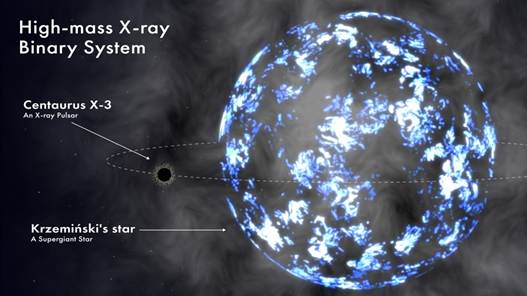
Scientists studying a well-known neutron star have detected pulsing signals that are providing new insights into the complex structure surrounding the extreme stellar object.
Neutron stars are the extraordinarily dense remnants of massive stars that have undergone supernova explosions. Their intense gravity and magnetic fields create some of the most extreme environments known in the Universe. Studying their emissions allows researchers to investigate how matter and energy behave under conditions that cannot be reproduced on Earth.
The newly observed pulsing signals offer clues about material and structures around the neutron star. By analysing changes in the signals over time, researchers can investigate the geometry, movement and physical conditions of the surrounding environment.
Such observations are particularly valuable because neutron stars can act as natural laboratories for testing models of high-energy astrophysics. The timing and characteristics of their pulses can reveal information about processes occurring close to the stellar surface and in the surrounding region.
The findings add another piece to the scientific understanding of neutron stars and demonstrate how precise observations of cosmic signals can uncover structures that are otherwise difficult to observe directly.
As astronomers continue to monitor these powerful stellar remnants, observations of their pulsing emissions could provide further insights into the physics of extreme matter, magnetic fields and high-energy processes in the Universe.