
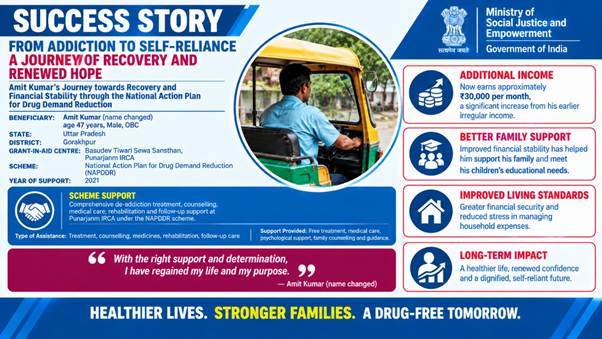
A journey marked by addiction, financial hardship and social isolation has transformed into one of recovery, self-confidence and economic stability for Amit Kumar, a 47-year-old resident of Gorakhpur district, with support provided under the National Action Plan for Drug Demand Reduction (NAPDDR).
Amit Kumar, whose name has been changed, faced personal and economic difficulties after developing a habit of smoking and using addictive substances. His addiction affected his physical and mental well-being, confidence, family relationships and ability to maintain regular employment.
After undergoing treatment in 2018 and later experiencing a relapse, Amit once again decided to seek help and rebuild his life. On August 13, 2021, he received support under NAPDDR through Basudev Tiwari Sewa Sansthan’s Punarjanm Integrated Rehabilitation Centre for Addicts (IRCA) in Gorakhpur.
The centre provided him with free de-addiction treatment, medical care, prescribed medicines, psychological counselling and motivational support. Regular counselling and follow-up care, along with family counselling, helped him remain committed to recovery and gradually rebuild his confidence and relationships.
With sustained support and his own determination, Amit successfully quit smoking and substance use. Following his recovery, he resumed work and established a livelihood by driving his own auto-rickshaw.
Today, Amit earns approximately ₹30,000 per month, providing him with a more stable source of income and enabling him to contribute consistently to household expenses.
His journey highlights the importance of accessible de-addiction treatment, psychological support, family involvement and rehabilitation in helping individuals overcome substance dependence and return to productive lives.
Amit’s transformation from addiction and economic uncertainty to recovery and livelihood security serves as an encouraging example of resilience and renewed hope, demonstrating how timely intervention and sustained support can help individuals regain dignity, strengthen their families and move towards self-reliance.