

A tiny fluorescent “turn-on” sensor for rapidly detecting nicotine and its major metabolite, cotinine, in aqueous media and living cells, could enable early and rapid detection of nicotine exposure and biomarkers levels of cotinine its long-lasting footprint in the body. Smoking and second-hand smoke exposure remain major global health issues. Nicotine is highly addictive and harmful, while cotinine is a stable biomarker present in blood, saliva, and urine. Therefore, developing a selective and biocompatible probe for nicotine/cotinine detection is important for public health screening, monitoring smoking exposure and biological and cellular research related to nicotine metabolism.
Conventional nicotine/cotinine detection methods (GC-MS, HPLC, electrophoresis, immunoassays) are expensive, time-consuming, require skilled operators, and need complex sample preparation. Scientists from Institute of Nano Science and Technology (INST), Mohali, an autonomous institute of the Deparyment of Science and Technology (DST) have developed a sensor using an iron metal-organic framework (Fe-III-MOF) nanosphere a microscopic, sponge-like structure made from iron.
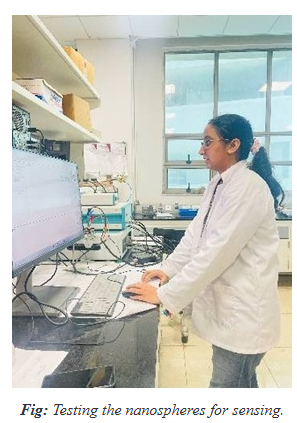
The scientists synthesised the Fe-MOF nanospheres through a process called solvothermal process, tested them for safety and effectivity. This material is full of tiny pores that can trap molecules like nicotine. Using intracellular imaging and confocal microscopy to follow the cellular uptake they found that when molecules like nicotine or cotinine entered the pores, the nanosphere began to glow brighter with shift towards blue.
The nanosphere reported in the journal Nanoscale, was also found to be highly selective recyclable. The researches have suggested that fluorescence enhancement occurs due to host–guest interactions and electron transfer, leading to a stronger emission signal. It is also simple to operate and works in aqueous medium.
The abundance of iron makes the Fe-based MOFs a convenient, safe option suitable for biological applications like non-invasive health monitoring, medical and research studies related to smoking, addiction, and metabolism, potential future development of low-cost sensing kits and safer biological detection due to low cytotoxicity and high biocompatibility.
It could help public health monitoring and smoking biomarker screening, rapid low-cost screening for tobacco exposure and Fluorescent MOF-based biosensing platforms for other biomarkers.
Publication link: DOI: 10.1039/D5NR00785B