

Deodhar trees in Batseri, a scenic village in Sangla valley on the Baspa River in Himachal Pradesh have revealed a story of shift from wetter spring conditions during Little Ice Age (LIA) to progressive drier conditions since after 1757 CE, with increased spring drought years in recent decades, buried in their rings.
The study analyses the factors responsible for the geohazard activities enabling better prediction of future hazard events to support early warning systems.
The increasing frequency of extreme climatic events, such as droughts and floods, and their strong association with geohazards like landslides, glacial lake outburst flood (GLOFs), rockfalls and snow-avalanches specially in the Himalayan region underscored the need for robust reconstructions of past hydroclimatic variability and related geohazard episodes.
Tree-rings, which are layers of new wood that form each year, providing a record of the tree’s age and past environmental conditions act as natural archives to such climatic and geohazard events, offering the potential to bridge this knowledge gap. The idea was further motivated by the absence of long-term high-resolution records and need to understand the interactions between moisture variability and geohazard dynamics from the Himalayan region.
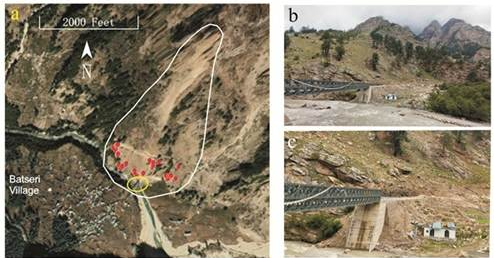
A rockfall episode in July 2021 near village Batseri in Kunnaur, Himachal Pradesh, led The Birbal Sahni Institute of Palaeosciences (BSIP), an autonomous institute of the Department of Science and Technology (DST) to explore past climates using dating of annual growth layers in trees (dendroclimatology and dendrogeomorphology).
They integrated dendroclimatology and dendrogeomorphology for future risk assessments and mitigation strategies. Tree-ring analysis of Deodar (Cedrus deodara) trees helped reconstruct a 378-year (1558-2021 CE) spring months’ moisture history and a 168-year (1853-2021 CE) rockfall activity record at Batseri, Kinnaur, Himachal Pradesh, western Himalayas. The study showed that tree growth is highly sensitive to spring months’ (February to April) moisture, primarily influenced by winter precipitation derived through Western Disturbances (WDs).
A total of 53 rockfall events, including 8 of high intensity, were linked to dry spring conditions, especially after year 1960, indicating climate-induced ground instability. The spring drought conditions led to slopes with poor vegetation cover, exposing them to vulnerability when the dry conditions are followed by the intense summer monsoon rainfalls.