

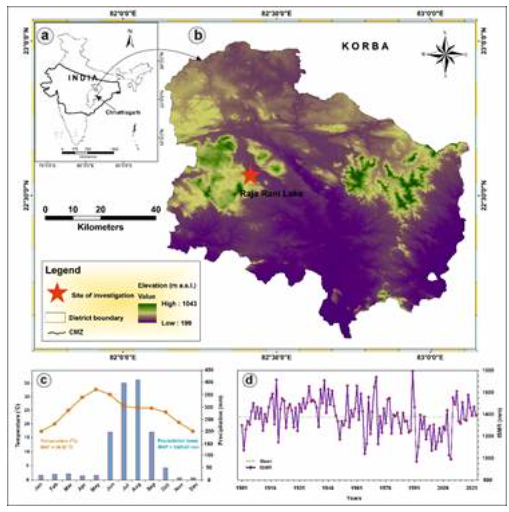
India may have faced a much stronger monsoon than earlier believed. Scientists have found evidence of intense rainfall, rain, forests, and climate change roughly between 1,060 and 1,725 CE in central India hidden in the Raja Rani Lake of Korba district of Chhattisgarh. Understanding the vegetation dynamics and corresponding hydro-climate variability from the Core Monsoon Zone (CMZ), wherein the rainfall is essentially controlled by the ISM which contributes to 89 to 90 percent of India’s rainfall, could be crucial in understanding the monsoonal variability during the Late Holocene (Meghalayan Age) particularly as the CMZ is sensitive to ISM fluctuations.
Scientists from the Birbal Sahni Institute of Palaeosciences (BSIP), Lucknow, an autonomous institute of the Department of Science and Technology (DST) have found evidence of unusually strong Indian Summer Monsoon (ISM) in ancient pollen grains preserved in lake sediments in Raja Rani Lake, Korba district, Chhattisgarh, right in the heart of India’s Core Monsoon Zone (CMZ).
Researchers extracted a 40-centimetre-long sediment core from Raja Rani Lake. The mud records revealed environmental changes going back about 2,500 years. Within these layers lie microscopic pollen grains shed by plants that once grew around the lake. By identifying and counting these pollen grains, a science known as palynology—researchers reconstructed past vegetation and, in turn, past climate. Forest-loving plants pointed to to warm and humid conditions, while grasses and herbs suggested drier phases.
During the Medieval Climate Anomaly, the pollen record showed a clear dominance of moist and dry tropical deciduous forest species, indicating strong monsoon rainfall and a warm, humid climate in central India. Crucially, the study found no evidence of contrasting dry conditions within the Core Monsoon Zone during this period.
The scientists traced this strong monsoon to a global warm phase known as the Medieval Climate Anomaly (MCA), roughly between 1,060 and 1,725 CE. The study attributes the enhanced monsoon to a combination of global and regional factors La Niña–like conditions, which are typically associated with stronger Indian monsoons, northward movement of the Inter Tropical Convergence Zone (ITCZ), positive temperature anomalies, increased sunspot numbers and high solar activity could be driving the climate change and increased ISM during the MCA.
This understanding of the Indian Summer Monsoon (ISM) and related climate change variability during the Holocene could be of immense interest in order to strengthen our understanding of the present ISM-influenced climatic conditions, as well as of possible future climatic trends and projections. Moreover, the high-resolution palaeoclimatic records generated in the present study could be helpful in developing paleoclimatic models for the simulation of future climatic trends and rainfall patterns and also for a scientifically sound policy planning with a key aspect of societal relevance.