

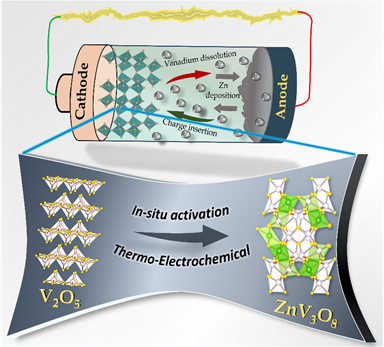
Bengaluru based scientists have unveiled a breakthrough that could power the next generation of eco-friendly batteries. Moving beyond lithium batteries, the currently favourite one, researchers have designed a cathode material suitable for the more environment friendly Zinc batteries. This can enhance the energy density and stability of the materials resulting in more efficient batteries.
Significant advances in energy storage over the past few decades have been focused largely around lithium batteries because of their desirable performance – mainly high energy density, although they come with several environmental and safety risks during use. As an alternative, recently, aqueous zinc-ion-based battery (ZIB) systems have been attracting attention due to their high energy storage capacity, safety, and environmental friendliness.
Researchers around the world are developing various cathode materials that can be suitable for zinc-ion-based electrolyte systems and can last for a long time with high energy storage capacity. Several oxide materials are already being investigated in this regard, but have failed to demonstrate the required performance in zinc-ion-based systems due to many limitations.
To solve that, a research team led by Dr. Ashutosh Kumar Singh of the Centre for Nano and Soft Matter Sciences (CeNS), an autonomous institute under the Department of Science & Technology (DST), Government of India, have come up with a new simple strategy to activate the cathode material by thermo-electrochemical treatment to modify its structure. This could help the batteries gain high energy storage performance. This represents a straightforward and efficient approach to enhancing the overall energy density and stability of the usual cathode materials.