

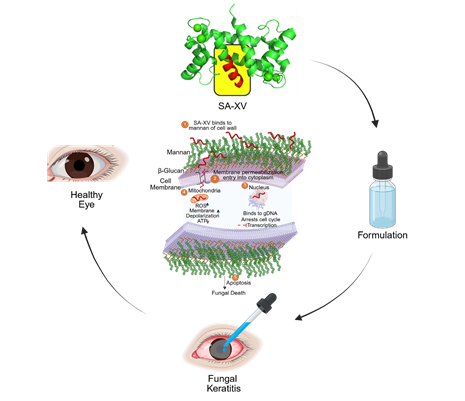
A recent study offers a promising, multidisciplinary approach to treating fungal keratitis — a severe, sight-threatening infection of the cornea, the clear front part of the eye, caused by a fungal organism. It opens new avenues in the search for antimycotics with reduced side effects.
Corneal infections, often referred to as a slow epidemic, affect a significant portion of the population in India, particularly among those with agricultural backgrounds. In contrast, overuse and poor hygiene practices related to contact lenses are major contributors to corneal infections. Currently, amphotericin B is the only drug available to treat fungal infections. However, its use is limited due to nephrotoxicity and high hemolytic activity. This creates an urgent need for the development of potent antimycotic drugs that are safe for mammalian cells.
L V Prasad Eye Institute in Hyderabad, in collaboration the Bose Institute in Kolkata, an autonomous institute under the Department of Science and Technology, Government of India, have designed a 15-residue peptide, named SA-XV, derived from a larger host-defense peptide, S100A12. This peptide, previously shown to inhibit fungal growth, has been characterized for its antifungal potency and mechanism of action.
In their recent publication in the,” Journal of Biological Chemistry”, Dr. Sanhita Roy and her team from L V Prasad Eye Institute and Professor Anirban Bhunia and his team from Bose Institute along with other collaborators, reported that these antimicrobial peptides are non-toxic, serum-stable, and effective in inhibiting the growth of both planktonic and biofilm forms of Fusarium and Candida species.
They also demonstrated that SA-XV reduced the severity of keratitis in mouse models. The study revealed the peptide’s mechanism of action: SA-XV first interacts with the fungal cell wall and plasma membrane, then translocates across the cell membrane and accumulates in the cytoplasm. The peptide subsequently colocalizes in the nucleus, binding to genomic DNA and halting the cell cycle. Finally, it targets the mitochondria, permeabilizes them, and induces fungal cell death through apoptosis.
This study highlights SA-XV’s dual potential; it is not only an antifungal agent but also for promoting wound healing in corneal infections. The findings suggest that SA-XV could become a novel therapeutic option for treating fungal infections and accelerating corneal wound healing, offering an alternative to current treatments.