

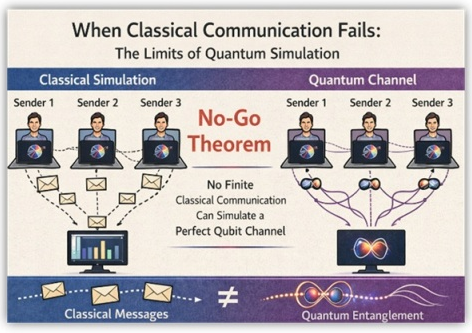
In a rapidly evolving digital landscape, scientists and technology experts are increasingly emphasizing that classical messaging systems cannot substitute quantum communication channels, owing to fundamental differences rooted in the laws of physics.
Unlike traditional communication methods that rely on binary bits, quantum communication operates using qubits, enabling advanced features derived from phenomena such as quantum entanglement and superposition. These properties allow quantum systems to establish correlations and process information in ways that classical systems cannot replicate.
One of the defining advantages of quantum communication is its inherent security. Based on the no-cloning theorem, quantum information cannot be copied without altering its state. This principle ensures that any attempt at eavesdropping can be immediately detected, a feature leveraged in technologies like Quantum Key Distribution (QKD).
In contrast, classical messaging relies on encryption techniques that are dependent on computational complexity. With the advent of more powerful computing technologies, including quantum computers, such encryption methods could become vulnerable in the future.
Experts note that while classical and quantum systems can work together in hybrid communication frameworks, the unique capabilities of quantum channels—particularly in terms of security and information processing—remain unmatched.
As nations and industries invest heavily in quantum networks, the consensus is clear: classical messaging will continue to play a supporting role, but it cannot replace the transformative potential of quantum communication.