

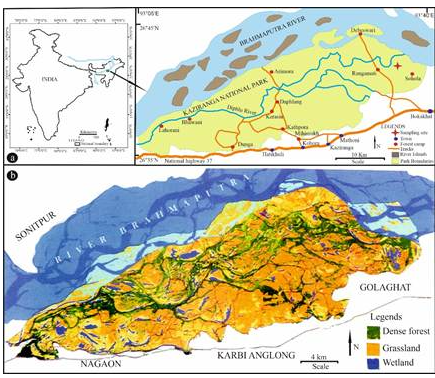
Researchers have traced the long ecological and geological evolution of Kaziranga, revealing how a dynamic landscape shaped by rivers, floods, and grasslands gradually emerged as the world’s last major stronghold of the one-horned rhinoceros.
According to the study, Kaziranga’s transformation into a biodiversity-rich habitat is closely linked to the natural behaviour of the Brahmaputra River and its tributaries. Seasonal flooding, which once posed serious challenges to wildlife, played a vital role in renewing nutrient-rich soil and sustaining vast stretches of tall grasslands that form the primary habitat of the one-horned rhino.
Scientists explained that, historically, the Indian one-horned rhinoceros had a much wider distribution across the floodplains and grasslands of the Indian subcontinent. Over centuries, large-scale changes in land use, deforestation, hunting, and human settlement led to a sharp contraction of its habitat, pushing the species to the brink of extinction.
Kaziranga’s relatively intact floodplain ecosystem, combined with early recognition of its ecological importance, allowed it to survive when many other habitats disappeared. The area was declared a reserve forest in the early 20th century and later gained national park status, enabling stricter protection and scientific management.
Researchers highlighted that the interaction between grasslands, wetlands, forests, and river channels created a mosaic of habitats uniquely suited to the rhino’s needs. This ecological diversity also supports a wide range of other wildlife, including elephants, wild buffalo, swamp deer, and numerous bird species, making Kaziranga one of the most biologically significant landscapes in Asia.
The study also underlined the role of sustained conservation efforts, including anti-poaching measures, habitat management, and community engagement, in stabilising and increasing the rhino population. From a few dozen individuals in the early 1900s, the one-horned rhino population in Kaziranga has grown steadily, accounting for the majority of the global population today.
However, researchers warned that new challenges are emerging. Climate change, increasing intensity of floods, erosion caused by shifting river courses, and growing human activity around the park threaten to alter the fragile balance that sustains the ecosystem. Understanding the historical evolution of Kaziranga, they said, is critical for designing adaptive conservation strategies for the future.
The findings offer valuable insights not only into the past of Kaziranga but also into how dynamic landscapes can be protected to ensure the long-term survival of endangered species. Researchers believe the lessons from Kaziranga could inform conservation efforts in other floodplain ecosystems across the world.