

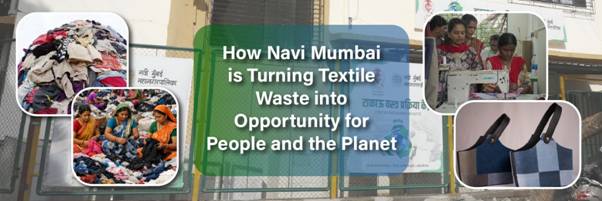
In a pioneering step towards sustainable urban waste management, the Navi Mumbai Municipal Corporation (NMMC) has launched India’s first municipal Textile Recovery Facility (TRF), transforming discarded clothes into economic and environmental assets. The initiative, implemented under Swachh Bharat Mission–Urban 2.0, addresses a growing challenge—India generates nearly 7.8 million tonnes of textile waste annually, much of which ends up in landfills.
Located in Belapur, the TRF operates as a circular economy hub, integrating collection, scientific sorting, recycling and livelihood generation. Textile collection bins have been installed across residential societies in all eight municipal wards, encouraging citizens to participate in waste segregation at the source.
At the facility, collected textiles are weighed, tagged and sorted into categories such as reusable, recyclable and upcyclable. Advanced tools like handheld fibre scanners help identify materials—cotton, polyester, wool and silk—ensuring efficient processing and higher recovery rates.
The initiative has a strong social dimension. Over 150 women from self-help groups are currently employed in sorting, stitching and upcycling activities, earning between ₹9,000 and ₹15,000 per month. These workers convert discarded fabrics into bags, garments, mats and home décor products, which are later sold at exhibitions.
So far, the project has processed over 41,000 textile items and collected around 30 metric tonnes of waste, significantly reducing landfill burden. It has also engaged more than 1.1 lakh households, reflecting widespread community participation. Officials say the TRF model demonstrates how urban waste streams can be reimagined as engines of green jobs and sustainable enterprise. With plans to establish a larger, permanent facility in Koparkhairane, Navi Mumbai aims to scale up the initiative as a model for other Indian cities.
Experts believe such efforts align with global sustainability goals by promoting responsible consumption, recycling and circular resource use, while simultaneously empowering local communities.