

Advanced numerical simulations of the Sun have uncovered a powerful “magnetic cage” structure that appears to regulate the intensity and eruption of solar storms, offering fresh insight into the dynamics of space weather.
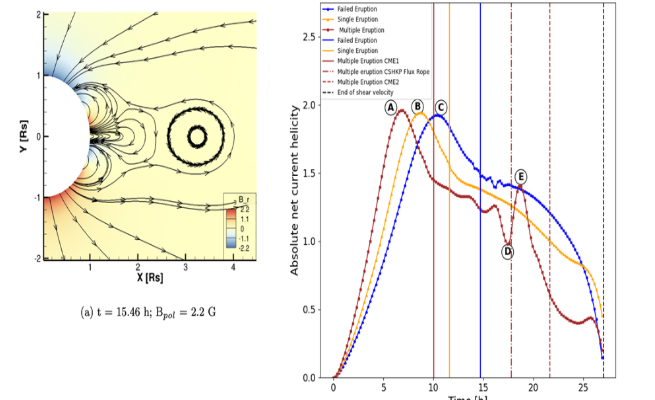
Using high-resolution computational models, scientists observed that complex magnetic field lines in the Sun’s outer atmosphere form a cage-like structure around active regions. This magnetic cage can either confine or release massive bursts of solar energy, including solar flares and coronal mass ejections (CMEs).
Solar storms originate from intense magnetic activity on the Sun’s surface and can disrupt satellites, communication networks, power grids, and navigation systems on Earth. The simulations suggest that when the magnetic cage remains stable, it suppresses large eruptions. However, if the cage weakens or breaks, pent-up energy is suddenly released, triggering powerful solar storms.
The findings improve understanding of how magnetic forces govern solar activity and may significantly enhance space weather forecasting. By identifying the conditions that destabilize the magnetic cage, scientists hope to better predict when major solar eruptions are likely to occur.
This breakthrough marks an important step in heliophysics research, strengthening efforts to protect Earth’s technological infrastructure from the impacts of extreme space weather.