

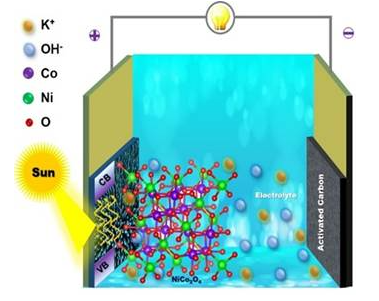
In a major boost to India’s clean-energy research, Indian scientists have developed a self-charging energy storage device that can directly harvest and store solar energy, eliminating the need for separate solar panels and batteries. The innovation is expected to pave the way for compact, efficient and sustainable power solutions for future electronics and off-grid applications.
The device has been developed by researchers at the Centre for Nano and Soft Matter Sciences (CeNS), Bengaluru, an autonomous institute under the Department of Science and Technology (DST). Described as a photo-rechargeable supercapacitor, the technology combines energy conversion and storage into a single integrated system, reducing energy losses and overall system complexity.
Unlike conventional solar power setups—where sunlight is first converted into electricity using photovoltaic panels and then stored in batteries—the newly developed device performs both functions simultaneously. When exposed to sunlight, it automatically charges itself, making it a promising alternative for next-generation renewable energy systems.
At the core of the innovation is a specially engineered electrode made from binder-free nickel-cobalt oxide (NiCo₂O₄) nanowires grown on a nickel foam substrate. This nanostructured design creates a highly porous and conductive network that efficiently absorbs sunlight while facilitating rapid charge storage. The material choice also enhances durability and electrochemical stability.
Laboratory tests showed that the device’s capacitance increased by about 54 per cent under solar illumination, indicating a significant improvement in energy storage performance. The supercapacitor delivered a stable output of around 1.2 volts and retained nearly 88 per cent of its capacity after 1,000 photo-charging cycles. Even after extensive testing of more than 10,000 charge-discharge cycles, the device maintained close to 85 per cent capacity retention, highlighting its long-term reliability.
Scientists involved in the project said the technology could be particularly useful for portable electronics, wearable devices, wireless sensors and remote monitoring systems, where compact size and self-sufficiency are critical. It also holds promise for off-grid and rural applications, where access to conventional electricity infrastructure remains limited.
Experts note that integrating energy harvesting and storage into a single platform could significantly lower costs and improve efficiency in renewable energy systems. By reducing dependence on traditional batteries, the technology may also help address environmental concerns related to battery disposal and resource use.
The research findings have been published in the international journal Sustainable Energy & Fuels. Officials from the Department of Science and Technology said the development reflects India’s growing capabilities in advanced materials and clean-energy technologies and aligns with national goals of promoting sustainable and indigenous innovations.
Further work will focus on scaling up the technology and exploring its commercial viability, with researchers optimistic that the device could play a key role in future solar-powered systems.