

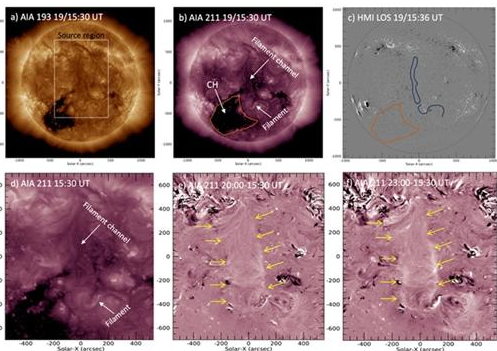
An intense geomagnetic storm that recently impacted Earth has drawn scientific attention to the underestimated role of subtle solar eruptions, challenging the long-held belief that only massive solar blasts can significantly disturb space weather.
Researchers say the storm was triggered by a series of relatively weak coronal mass ejections (CMEs)—clouds of magnetised plasma released from the Sun—that, despite their modest appearance, interacted in a way that amplified their impact on Earth’s magnetosphere. The event led to temporary disturbances in satellite operations, radio communications, and navigation systems, while also enhancing auroral activity at unusually low latitudes.
Traditionally, severe geomagnetic storms have been linked to powerful and fast CMEs originating from large solar flares. However, scientists analysing this event found that even slow-moving or faint CMEs, when aligned favourably with Earth’s magnetic field, can cause significant space weather effects.
“The storm clearly shows that intensity alone is not the whole story,” scientists involved in the analysis noted. “The magnetic orientation and interaction of solar eruptions play a crucial role in determining how strongly Earth is affected.”
Data from space-based observatories revealed that the CMEs involved carried magnetic fields oriented opposite to Earth’s own field. This configuration allowed for efficient magnetic reconnection—a process that transfers energy from the solar wind into Earth’s magnetosphere—resulting in a stronger-than-expected geomagnetic response.
The findings carry important implications for space weather forecasting, especially as solar activity increases during the current solar cycle. With growing dependence on satellite-based infrastructure for communication, weather monitoring, navigation, and defence, even moderate geomagnetic storms pose operational risks.
Indian scientists are also closely studying such events using observations from ISRO’s Aditya-L1 solar mission, which is positioned to continuously monitor the Sun and the solar wind. Insights from these observations are expected to improve early warning systems and help authorities better prepare for space weather-related disruptions.
Experts caution that underestimating weak CMEs could lead to gaps in forecasting models. “This storm is a reminder that space weather threats are not always obvious,” a senior space scientist said. “Smaller solar events can combine or evolve in ways that produce outsized effects at Earth.”
As the Sun approaches the peak of its activity cycle, scientists emphasise the need for continuous monitoring and refined prediction models. The recent geomagnetic storm serves as a timely warning that in space weather, even subtle solar changes can have far-reaching consequences for life and technology on Earth.