

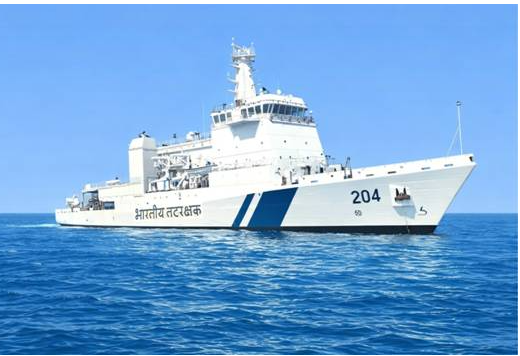
Raksha Mantri Shri Rajnath Singh today commissioned the Indian Coast Guard Ship (ICGS) Samudra Pratap, marking a major milestone in India’s maritime capability and environmental protection efforts. The vessel — the first indigenously designed and built Pollution Control Vessel (PCV) — was formally inducted into the Indian Coast Guard at a ceremony held in Goa.
Built by Goa Shipyard Limited (GSL) with over 60 % indigenous content, Samudra Pratap is the largest ship in the Coast Guard’s fleet and the first of two PCVs constructed to enhance India’s maritime pollution response and coastal security infrastructure. Speaking at the event, Raksha Mantri Singh emphasised the vessel as a symbol of India’s growing self-reliance (Aatmanirbharta) in defence manufacturing and its expanding maritime capabilities. He highlighted the ship’s role in strengthening coastal patrols, environmental protection, search and rescue operations, and overall maritime safety.
Samudra Pratap measures approximately 114.5 metres in length, displaces about 4,200 tonnes, and can achieve speeds exceeding 22 knots. Equipped with state-of-the-art pollution detection and response systems, the vessel will lead efforts to contain and manage oil spills and other environmental hazards in India’s vast Exclusive Economic Zone (EEZ).
Officials noted that the ship enhances the Coast Guard’s operational reach and reflects India’s commitment to both maritime environmental stewardship and national security.
Background: Samudra Pratap was delivered to the Indian Coast Guard in December 2025 following its construction at GSL and now joins the service’s fleet to address pollution control and multi-role missions across India’s coastal waters.