

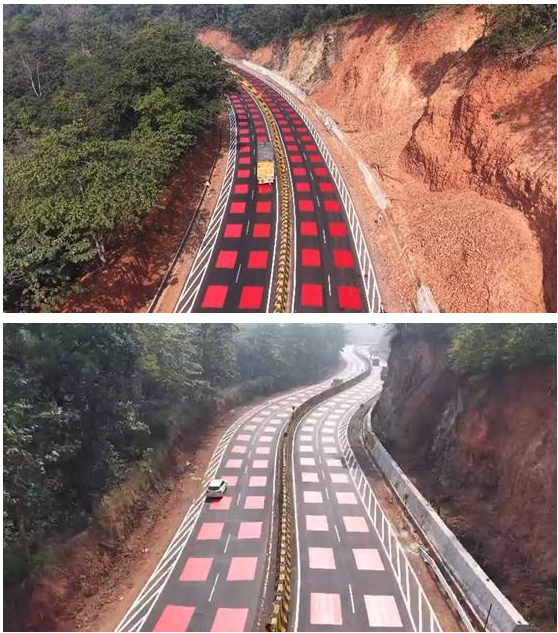
In a significant step towards balancing infrastructure development with environmental conservation, the National Highways Authority of India (NHAI) has introduced innovative safety and ecological measures on national highways passing through forest and wildlife corridors.
As part of this initiative, NHAI has implemented India’s first “table-top red road marking” system on a forest stretch of National Highway-45 in Madhya Pradesh. The bright red, raised markings act as a visual and tactile warning for motorists, encouraging them to slow down in wildlife-sensitive zones. The measure aims to reduce vehicle speeds naturally, lowering the risk of animal-vehicle collisions.
Complementing the red road markings, NHAI has developed a network of wildlife underpasses, protective fencing and designated animal crossings along vulnerable highway stretches. These structures help animals move safely between habitats without crossing fast-moving traffic, ensuring continuity of natural wildlife corridors.
The initiative aligns with NHAI’s broader Green Highways policy, which focuses on large-scale plantation drives, use of native species, and creation of dense green belts along highways. Techniques such as Miyawaki plantations are being adopted in select areas to improve forest cover, enhance biodiversity and reduce the ecological footprint of road projects.
Officials say the combined approach improves road safety for commuters while also supporting forest ecology and wildlife conservation. By integrating engineering solutions with environmental planning, NHAI aims to ensure that highways do not become barriers to wildlife movement.
The “Red Roads, Green Intent” model is being seen as a replicable framework for other national highway projects across the country, marking a shift towards eco-sensitive and sustainable infrastructure development in India.