

West Bengal is set to receive a significant boost in rail infrastructure as the Union Government accelerates investment, new projects and connectivity initiatives across the state — a push officials and political leaders say will transform regional mobility and economic growth.
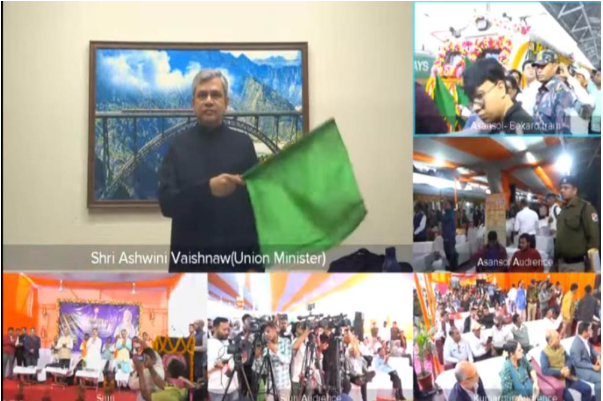
Union Railway Minister Ashwini Vaishnaw inaugurated the Siuri Road Over Bridge (ROB) and dedicated the Kumarpur ROB in Asansol, while also flagging off a new Asansol–Bokaro train service via video conferencing. The bridges are expected to reduce congestion, improve safety at rail crossings and enhance local accessibility for commuters, students and workers. The Asansol–Bokaro service will link major industrial hubs across West Bengal and neighbouring Jharkhand, further strengthening regional connectivity.
In the Union Budget 2026–27, West Bengal received a substantial allocation for rail infrastructure and safety projects, with officials reporting an estimated ₹14,205 crore earmarked for track creation, station upgrades and deployment of advanced safety systems like automatic train protection. Officials said ongoing projects totalling around ₹92,974 crore are also progressing across the state, underlining long-term investment in the sector.
The Indian Railways earlier this year launched the first Vande Bharat Sleeper Express between Howrah and Guwahati (Kamakhya), cutting travel times and offering enhanced comfort on one of the region’s busiest corridors. The service is seen as part of a broader push to modernise premium long-distance travel originating in West Bengal.
The Railway Ministry has approved multiple new railway line projects in West Bengal’s North 24 Parganas and Nadia districts, covering over 53 km of new track that will improve connectivity near the India–Bangladesh border and support economic activity in rural and semi-urban regions.
Beyond these, plans for high-speed rail links and freight corridors that involve West Bengal — such as the proposed Varanasi–Siliguri high-speed corridor and East–West Dedicated Freight Corridor connecting Dankuni with western India — are expected to further transform the rail landscape in coming years.
Officials and analysts say the combination of major budgetary outlays, new services, bridge infrastructure and network expansion positions West Bengal as a key focus of national rail development strategy. This push is expected to improve passenger convenience, boost freight efficiency, enhance trade linkages and foster broader socio-economic growth across the eastern corridor of the Indian Railways.