

Seven hundred light years away, astronomers studying molecular clouds that give birth to stars, have traced new clues about how magnetic fields guide the birth of stars. Their results, reveal that magnetic fields remain remarkably connected across these enormous changes in scale, and may play a decisive role in determining whether a star forms at all.
Molecular clouds, the birthplaces of stars, are characterized by their low temperatures (below 40 K, colder than liquid nitrogen) and relatively high densities (103–104 particles per cubic cm). The complex interplay between three key forces, namely gravity, magnetic fields, and turbulence, determines how these clouds collapse to form stars. Hence, the dynamics of the gas and dust needs to be studied from the scale of the molecular cloud down to the scale of the collapsing core for this purpose.
A new study, led by astronomers at the Indian Institute of Astrophysics (IIA), an autonomous institution under the Department of Science and Technology (DST), Government of India, focussed on the L328 molecular cloud, located around 700 light years away, to map the magnetic fields at multiple scales.
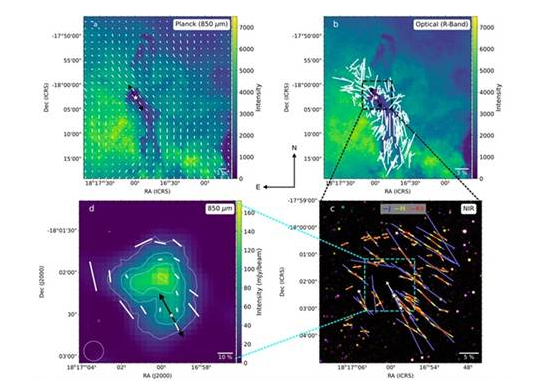
They have unveiled critical new observational evidence linking magnetic fields from the scale of molecular clouds down to the scale of dense star-forming cores using polarisation studies. “We chose to investigate the S2 sub-core in L328, since it is a Very Low Luminosity Object (VeLLO)”, explained Shivani Gupta of IIA, the first author of the study. S2 hosts a protostar, or a star in the making, with low luminosity and weak bipolar outflows. “These weak outflows cause minimal turbulence in their surroundings, making them ideal laboratories for studying primordial magnetic fields that existed before star formation began”, Gupta added.
To investigate the magnetic field structure in the L328 core, the team used polarimetric data from POL-2 on the James Clerk Maxwell Telescope in Hawai’i. Pol-2 observes polarised emission from dust grains at a wavelength of 850 microns. By analysing the directions of polarisation of light from various parts of the core, the researchers were able to map the morphology of the magnetic fields.
Archana Soam, a co-author and faculty member at IIA explains, “earlier studies of L328 had mapped the large-scale magnetic fields (over light years scale) using Planck satellite data, optical, and near-infrared (NIR) polarimetry. This work adds a new layer by zooming in to the core scale (sub-light year), where the star formation is actually taking place”.